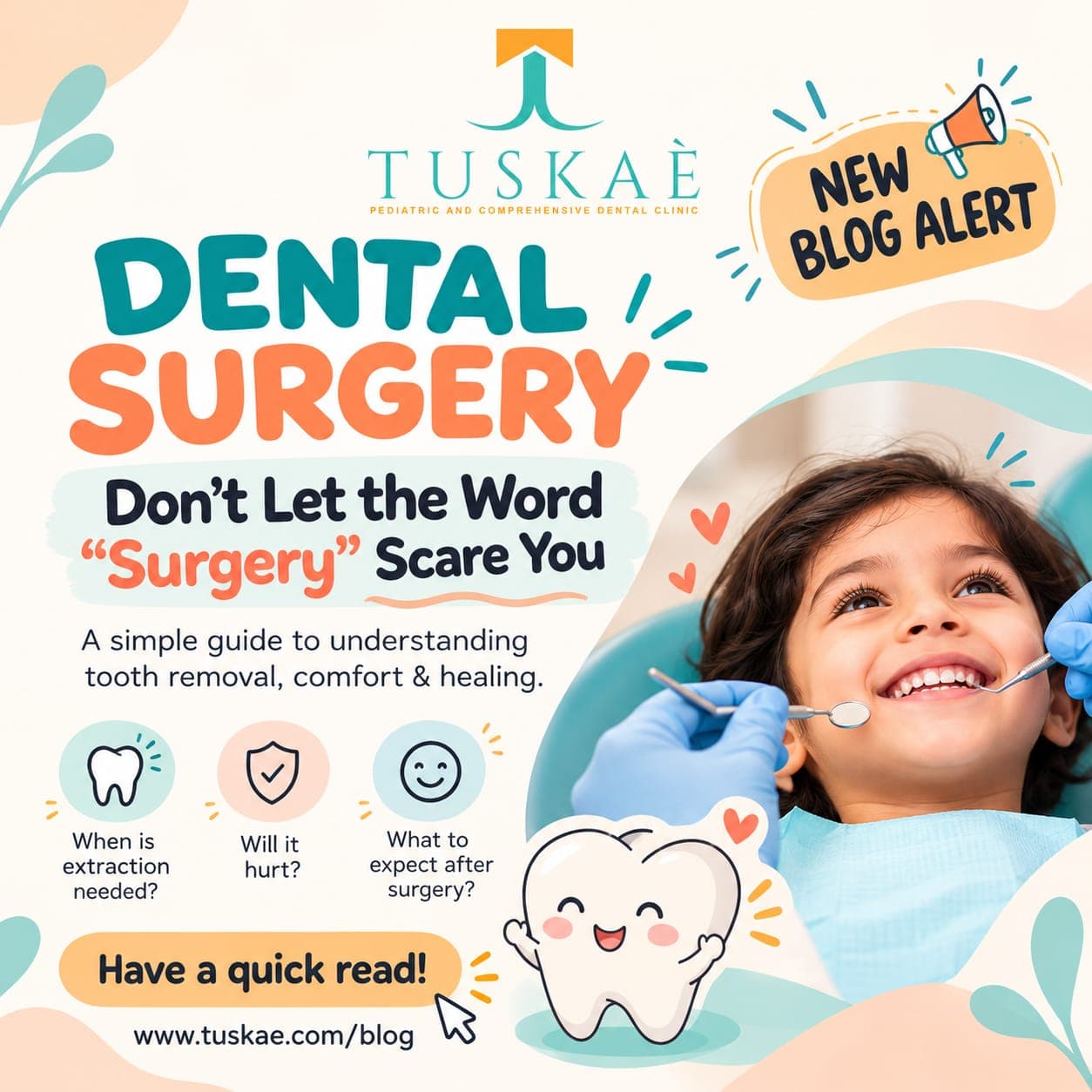
When you hear the words “surgical extraction” or “dental surgery,” it is completely natural to feel anxious. But the word “surgery” does not necessarily mean something frightening or dangerous. In dentistry, it often simply describes a procedure that requires careful access to a tooth or surrounding tissue.
When does a tooth need to be removed?
A tooth may be considered for extraction when:
- It is severely damaged or decayed and has a poor prognosis
- It cannot be predictably restored
- It is causing repeated infection or other problems
- It is preventing another tooth from erupting or reaching its normal position
- It is causing damage to neighbouring teeth or surrounding structures
- It is impacted, meaning it is unable to erupt normally
- Its position makes preservation impractical or unsafe
And importantly: extraction is not always the first choice. When a tooth can be predictably saved and restored, preserving the natural tooth is generally preferred.
Why is an extraction sometimes called “surgery”?
For a straightforward extraction, the tooth may be loosened and removed through the normal opening in the mouth. But when a tooth is deeply impacted, partially covered by gum, or surrounded by bone, the dentist may need to:
- Numb the area with local anaesthesia
- Carefully access the tooth through the gum
- Remove a small amount of surrounding bone when necessary
- Divide the tooth into smaller portions if that makes removal safer
- Gently remove the tooth
- Clean the area
- Place stitches when required
That additional access to the gum and/or bone is why the procedure is called a surgical extraction.
“Will it hurt?”
The procedure is performed under local anaesthesia, so the area being treated is numbed before treatment begins. You may feel pressure, movement or vibration, but you should not normally feel sharp pain during the procedure. If you are anxious, discuss your concerns with your dentist before treatment.
What if I am very anxious?
For appropriately selected patients, conscious sedation may be considered to help reduce anxiety and make the dental experience more comfortable.
It doesn't replace local anaesthesia—the treatment area is still numbed. Instead, sedation can help an anxious patient feel calmer and more relaxed while remaining responsive.
What if the case is complicated?
Some extractions are straightforward. Others require advanced surgical planning, particularly when a tooth is deeply impacted, close to important anatomical structures, or associated with other complications.
In such situations, an oral and maxillofacial surgeon may be involved. At Tuskaè, complicated cases can be appropriately assessed and referred or managed with specialist support when needed.
The key message
A surgical extraction is not something to fear simply because it contains the word “surgery.”
It is a carefully planned procedure performed to remove a problematic tooth while protecting the surrounding tissues and structures as much as possible.
The decision to remove a tooth should be based on its condition, prognosis, position and effect on your oral health—not simply on the fact that it is causing discomfort today.
Have a tooth that has been advised for extraction? Don't panic. Visit Tuskaè, let us evaluate whether it needs to be removed, whether it can be saved, and what the safest treatment option is for you.
Frequently Asked Questions
Is a surgical tooth extraction painful?
The procedure is performed under local anaesthesia, so the area is numbed before treatment begins. You may feel pressure, movement, or vibration, but you should not normally feel sharp pain during the procedure.
Does every impacted or difficult tooth need surgery?
No. A tooth is only considered for extraction when it is severely damaged, cannot be predictably restored, is causing repeated infection, is blocking another tooth, or its position makes preservation impractical. When a tooth can be predictably saved and restored, preserving it is generally preferred.
More from the Blog
View all
Connect With Our Specialists
For clinical inquiries or to schedule a visit for your family, reach out via our direct channels.