My Dental Bridge Has Become Loose. Can It Be Fixed, or Does It Need Replacing?
4 min read
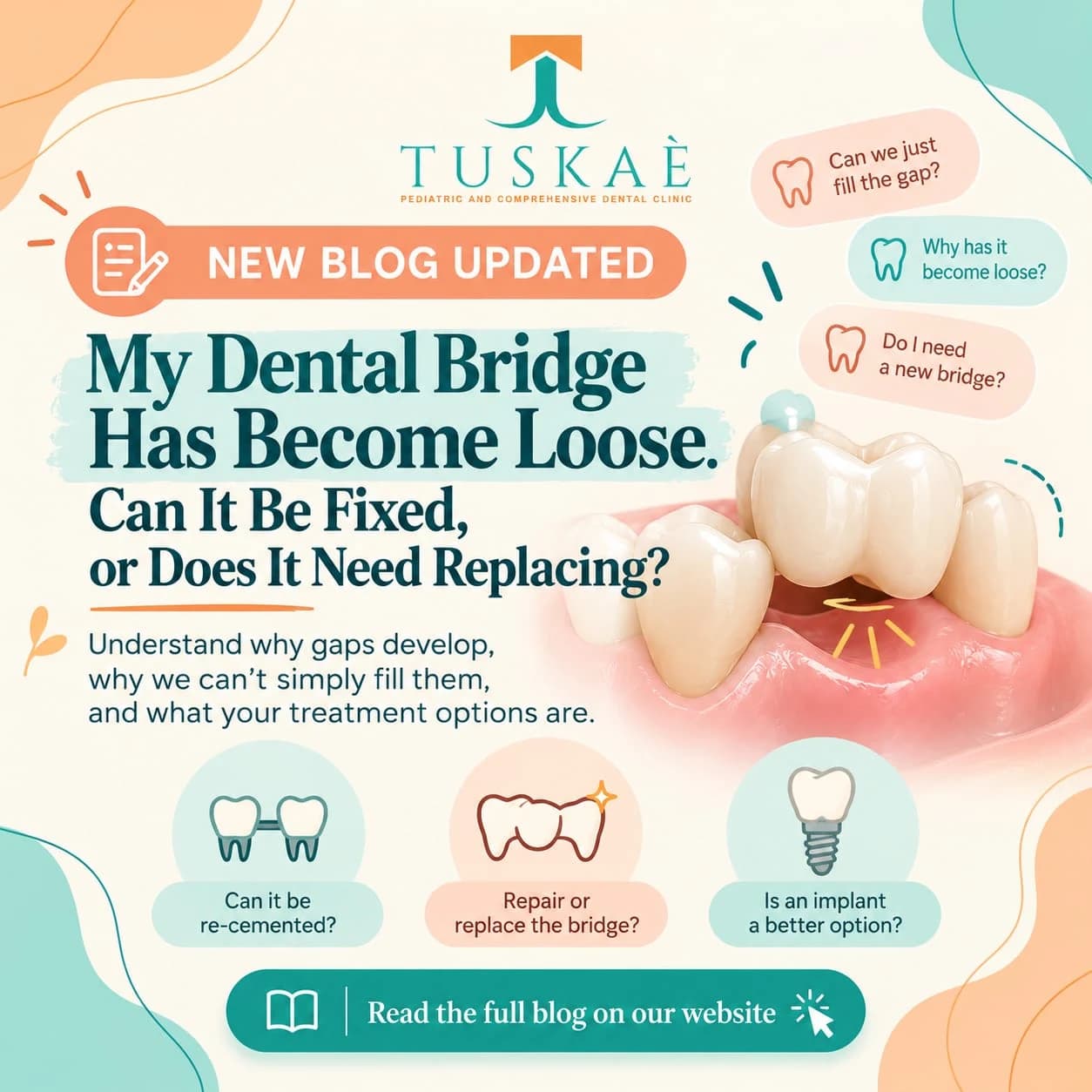
Imagine having a dental bridge for several years and then noticing a gap beneath the artificial tooth. Perhaps food keeps getting trapped there, or the bridge has started moving while you chew.
Naturally, you ask your dentist: “Can't you simply fill the gap? Why do I need a new bridge?”
A gap beneath a bridge and a loose bridge are not necessarily the same problem, and they may require different treatments.
1. Why Does a Gap Develop Between a Bridge and the Gums?
There are several possible reasons.
Changes in the gums and bone: after a tooth is extracted, the surrounding ridge can change shape over time. This may leave a space beneath the artificial tooth.
Pontic design: the artificial tooth replacing the missing tooth may have a contour that leaves a visible gap or makes cleaning difficult.
Defective restoration margins: if the gap is between the crown and the prepared supporting tooth, it may indicate a fit or margin problem that needs assessment.
Loss of retention: if the entire bridge has become loose, the cause may involve the cement, the supporting teeth, or the restoration itself.
Identifying which situation is present is essential before deciding on treatment.
2. Why Can't We Simply Fill the Gap?
The answer depends on the location and cause of the gap.
If the space is beneath the artificial tooth, simply adding restorative material may create an overcontoured surface that traps plaque, irritates the gums, or makes cleaning difficult. It also may not correct changes in the underlying gum or bone.
If the gap is at the margin of a crown, adding material over a defective margin is not a reliable substitute for correcting the underlying problem.
That does not mean every gap requires a new bridge. In selected cases, modifying the restoration or improving its contour may be possible. The dentist must determine whether the proposed correction would be biologically healthy, functional, and maintainable.
3. What If the Bridge Itself Is Loose?
The treatment depends on the condition of the restoration and the supporting teeth.
- Recement the existing bridge — if it is intact, fits properly, and the supporting teeth are healthy and restorable, recementation may be appropriate after investigating why it became loose.
- Repair or replace the bridge — if it is damaged, does not fit properly, or has an unsuitable design.
- Consider a different tooth-replacement option — if the supporting teeth have significant decay, fractures, or a poor prognosis, an implant-supported restoration or another suitable alternative may be considered.
A loose bridge should not simply be cemented back without assessing the underlying cause.
4. Can We Use Implants Instead of Another Conventional Bridge?
Yes, in suitable cases. A conventional bridge relies on natural teeth for support, whereas an implant-supported crown or bridge relies on dental implants placed in the jawbone.
If the supporting teeth are no longer suitable for another bridge, an implant-supported restoration may be considered after evaluating bone availability, gum health, medical history, and the overall treatment plan.
It is also possible to design a restoration that connects natural teeth and implants, but this requires careful planning because natural teeth and implants respond differently to chewing forces. Connecting them together is not automatically the best choice. Where appropriate, separate restorations supported independently by natural teeth and implants may be considered.
The goal is to preserve healthy, restorable teeth whenever possible and choose a replacement that can be maintained over the long term.
5. What Should You Do If Your Bridge Becomes Loose?
Do not ignore a moving bridge, even if it does not hurt.
- Avoid chewing hard or sticky foods on the affected side.
- Never attempt to glue the bridge back yourself.
- Arrange a dental examination promptly.
- If the bridge comes out, keep it safe and take it to your dentist.
Pain, swelling, or signs of infection warrant urgent dental assessment.
The takeaway: a gap beneath a bridge cannot always be corrected simply by filling it, but that does not mean every bridge must be replaced. Sometimes recementation is appropriate. Sometimes the bridge needs repair or replacement. In other cases, the supporting teeth need treatment or an alternative restoration is more suitable.
The right question is not simply, “Can we fill this gap?” It is, “Why has the gap or looseness developed, and what is the most predictable way to correct it?”
At Tuskaè, we believe that good dentistry begins with identifying the problem, explaining the available choices, and helping patients make informed decisions.
This article is for educational purposes and does not replace an individual dental examination.
Frequently Asked Questions
My dental bridge has become loose — can it just be re-cemented?
Sometimes, but not always. Recementation is appropriate when the bridge is intact, fits properly, and the supporting teeth are healthy and restorable — after first finding out why it came loose. If the bridge is damaged, doesn't fit well, or the supporting teeth have problems, repair, replacement, or an alternative like an implant-supported restoration may be needed instead.
Why is there a gap under my dental bridge, and can it just be filled?
A gap can develop from changes in the gum and bone over time, the shape of the artificial tooth, or a defective margin where the crown meets the supporting tooth. Simply filling the gap can trap plaque, irritate the gums, or fail to address the underlying cause, so the dentist first needs to identify why the gap formed before deciding on treatment.
Can a dental implant replace a failed bridge?
Yes, in suitable cases. If the teeth supporting the old bridge are no longer viable, an implant-supported crown or bridge can be considered after evaluating bone availability, gum health, and medical history. The choice depends on your specific findings, not a one-size-fits-all rule.
More from the Blog
View all

Connect With Our Specialists
For clinical inquiries or to schedule a visit for your family, reach out via our direct channels.