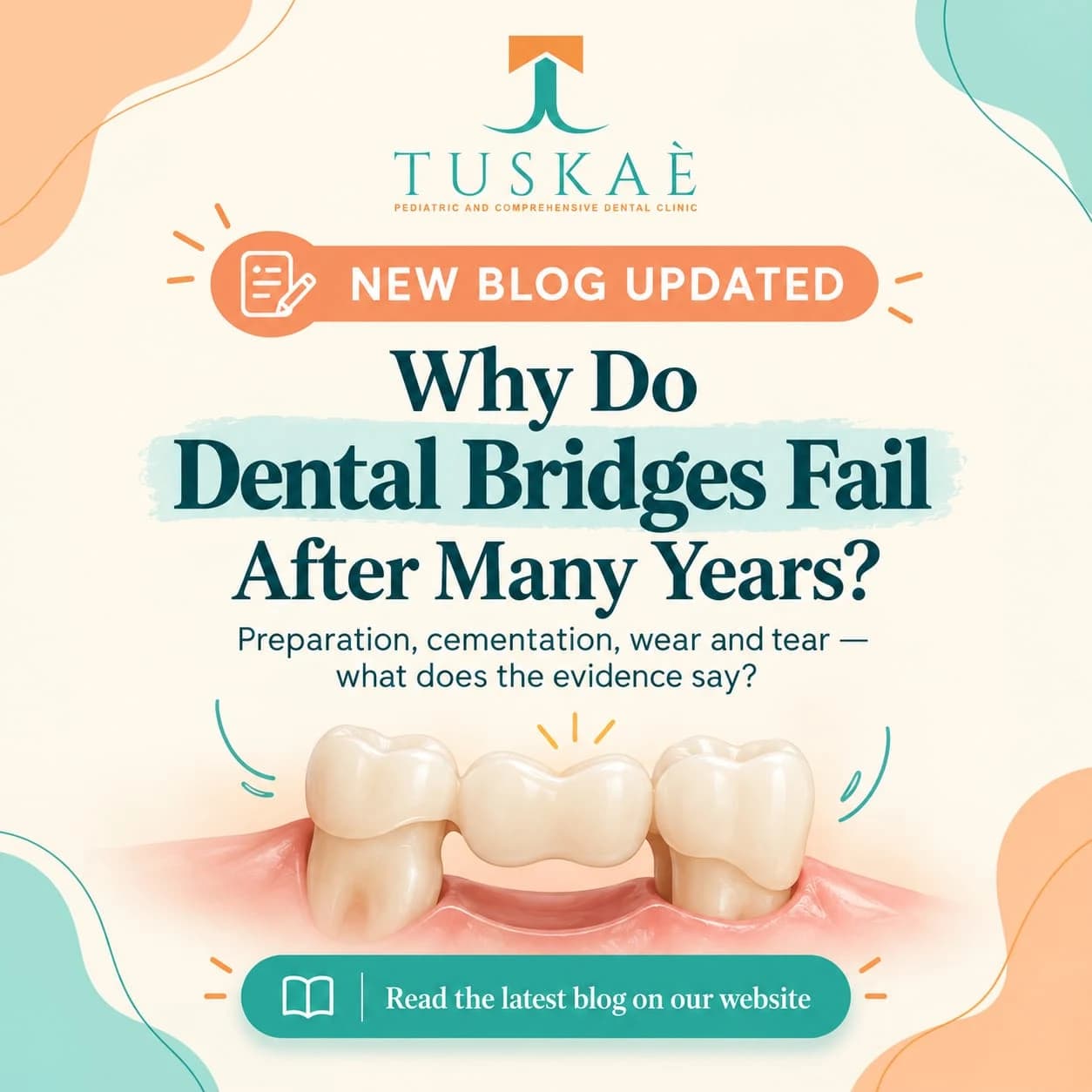
Have you ever had a dental bridge that worked perfectly for years but eventually became loose, chipped, uncomfortable, or painful?
Many patients wonder: Was the bridge not made properly? Did the cement fail? Or is this simply normal wear and tear?
The truth is that dental bridge failure can have several causes, and the age of the bridge alone cannot tell us why it failed.
Understanding How a Dental Bridge Works
A fixed dental prosthesis (FDP), commonly called a dental bridge, replaces missing teeth using supporting teeth called abutments. The artificial teeth replacing the missing teeth are called pontics.
For a bridge to function successfully, it needs an appropriate fit, adequate retention, healthy supporting teeth, and a design that withstands chewing forces while allowing good oral hygiene.
1. Could Tooth Preparation or Cementation Be Responsible?
Yes. The preparation of the supporting teeth influences how securely a conventional bridge stays in place. If the preparation does not provide adequate retention and resistance, the bridge may be more susceptible to loosening.
The cement used to attach the restoration also matters. Loss of retention can occur because of cement failure, inadequate mechanical retention, problems with fit, or challenges during cementation.
However, a bridge becoming loose years later does not automatically mean that the original treatment was incorrect. New decay, fractures, or changes in the supporting teeth can also affect its stability.
2. Can Normal Chewing and Ageing Cause a Bridge to Fail?
Our teeth and restorations experience repeated forces every day. Over time, these forces can contribute to ceramic chipping, fractures, material fatigue, or loss of retention. Grinding and clenching can increase these stresses.
But normal chewing does not mean every bridge is destined to fail.
A systematic review by Pjetursson and colleagues reported an estimated 10-year survival rate of 89.2% for conventional tooth-supported fixed dental prostheses. Survival does not necessarily mean that every restoration remained free from complications throughout that period.
3. What If the Supporting Teeth Develop Problems?
Sometimes the bridge itself is not the main problem. Decay can develop around the margins or beneath the crowns supporting a bridge. The supporting teeth may also develop pulpal disease, fractures, or periodontal problems.
These complications may affect a bridge even when its outer surface appears intact.
This is why regular dental examinations are important. Your dentist may recommend radiographs when indicated to assess the supporting teeth and investigate problems that cannot be identified through visual examination alone.
4. So, What Actually Causes Bridge Failure?
- Inadequate retention or loss of cementation.
- Decay or fractures involving the supporting teeth.
- Gum disease or changes in supporting tissues.
- Repeated chewing forces, grinding, or material fatigue.
- Problems with restoration fit, design, or maintenance.
More than one factor may be involved in the same case. It is not possible to determine the exact cause simply by looking at how old the bridge is.
Can a Dental Bridge Last a Lifetime?
Many bridges provide years of useful service, but no restoration can be guaranteed to last a lifetime.
The goal is to preserve the supporting teeth, maintain healthy gums, and identify complications early enough to manage them appropriately.
The takeaway: a failed bridge does not automatically mean poor dentistry, nor is failure always an unavoidable consequence of ageing. The important question is: why has the bridge failed, and what is the most appropriate way to restore function?
At Tuskaè, we believe that understanding the cause is the first step towards making an informed treatment decision.
This article is for educational purposes and does not replace an individual dental examination. Scientific reference: Pjetursson BE et al., Comparison of survival and complication rates of tooth-supported fixed dental prostheses and implant-supported restorations — PubMed: pubmed.ncbi.nlm.nih.gov/17594374
Frequently Asked Questions
Why do dental bridges fail after many years?
Bridge failure can involve several factors working together: loss of cementation or retention, decay or fractures in the supporting teeth, gum disease, repeated chewing forces and material fatigue, or problems with the original fit or design. Age alone doesn't explain why a bridge failed — it usually takes a dental exam, and sometimes radiographs, to identify the actual cause.
How long does a dental bridge typically last?
A systematic review reported an estimated 10-year survival rate of around 89% for conventional tooth-supported bridges. Many bridges give years of reliable service, but no restoration can be guaranteed to last a lifetime — regular check-ups help catch problems early.
Does a loose or failed bridge mean it was made incorrectly?
Not necessarily. A bridge becoming loose years after placement often reflects new decay, fractures, gum changes, or normal wear rather than a flaw in the original treatment. The right next step is identifying why it failed, not assuming the dentistry was at fault.
More from the Blog
View all

Connect With Our Specialists
For clinical inquiries or to schedule a visit for your family, reach out via our direct channels.